


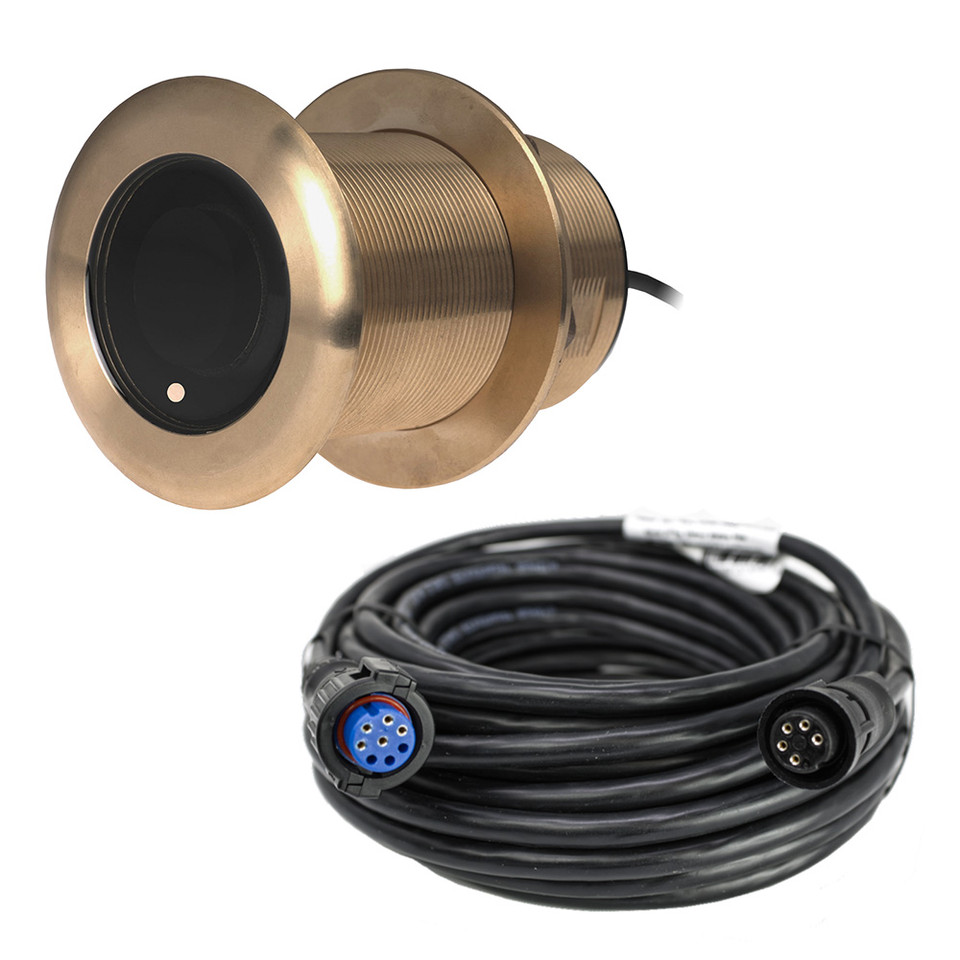
B75 High 20 Degree CHIRP Transducer 8-Pin for Garmin
Airmars Broadband/CHIRP transducers represent the next generation of technology that will allow fishermen to unlock secrets in fishfinding. Echosounder operation away from the traditional 50 kHz and 200 kHz has proven that different fish species return better signals at various frequencies. Airmars Broadband Transducers are capable of operating over a wide (or Broad) frequency band ranging from 25 kHz to 60 kHz and from 130 kHz to 210 kHz.
Traditional fishfinders transmit a pulse at a single frequency (50 kHz or 200 kHz), which is often referred to as a tone burst. Better deep-water and bottom detection is obtained by transmitting a longer pulse, because the fishfinder is delivering more energy to the transducer. However, the drawback of a long pulse is that it provides reduced target resolution. For example, if a fishfinder transmits a pulse that is 500 microseconds in duration, it has a pulse length of 0.7 m (2.4). With a tone burst, no targets can be resolved that are closer to one another than the pulse length. Fish less than 0.7 m (2.4) apart, or less than 0.7 m (2.4) from the bottom, can not be detected. Fish schools will appear in this case as a single large mass, while fish close to the bottom will appear attached to the sea bed and will be difficult or impossible to detect.
With CHIRP, the transmission pulses are typically very long and may start at 40 kHz and end at 60 kHz. By comparing the shape of the stored transmission pulse with the received echoes from the transducer, it is possible to find echoes in the noise and precisely determine their range with astounding accuracy.
Using CHIRP, it is now possible to obtain:
- Much greater range because very long pulses can be used.
- Much better resolution because the sonar pulse is swept across a frequency band (from 40 kHz to 60 kHz, for example).
- Enables targets to be precisely located within inches on the display using pattern-matching techniques.
- Closely spaced fish and fish lying on the bottom can be accurately detected and displayed as distinct targets.
Because weak fish and bottom echoes can be resolved within the noise (the snow on a conventional fishfinder display), it is possible both to detect targets at far greater depths than before and track the bottom at higher boat speeds.
Features:
- 12 m (40) cable
- Depth and fast-response water-temperature sensor
- Same elements and performance as the B765LH/LM offered in a low-profile housing
- Bronze transducer housing
- Boat Size: Up to 8 m (25)
- Hull Type: Fiberglass or wood